Bachtoberfest!
Bachtoberfest!
Aine Hakamatsuka and Marisa Curcio, sopranos
Eliana Barwinski and Gabriela Estephanie Solís, altos
Gene Stenger and Steven Caldicott Wilson, tenors
Harrison Hintzsche and Will Berman, baritones
Kako Miura and Isabelle Seula Lee, violins
October 19, 2025
Pre-concert talk: 3 pm
Concert: 4:00 p.m.
Richardson Auditorium
Princeton University
Bachtoberfest!
Aine Hakamatsuka and Marisa Curcio, sopranos
Eliana Barwinski and Gabriela Estephanie Solís, altos
Gene Stenger and Steven Caldicott Wilson, tenors
Harrison Hintzsche and Will Berman, baritones
Kako Miura and Isabelle Seula Lee, violins
October 19, 2025
Pre-concert talk: 3 pm
Concert: 4:00 p.m.
Richardson Auditorium
Princeton University
Welcome to the 2025-2026 season of Princeton Pro Musica! Over our fourteen seasons together, we’ve often returned to the music of J.S. Bach. Like many music-lovers and musicians, I’ve always held a special place in my heart for his music. This afternoon, we’re celebrating Bachtoberfest, so I turned to some of his most festive, exuberant music.
I can’t pinpoint exactly why I find myself returning again and again to Bach, but I suspect it has something to do with how engaging the music is—bodily, mentally, spiritually. My earliest entanglements with Bach’s music left me painfully aware of the gulf between its technical sophistication and my technical ineptitude, as my fingers fumbled across my piano keyboard and cello fingerboard. But even then, the reward outweighed the effort. The complexity of Bach’s music can frustrate, but it does not alienate. We naturally revel in the heightened sense of execution the music demands, whether we’re performing it or listening to it. In this way, the challenging nature of the music is the aesthetic experience. To see a Bach score on paper is to be overwhelmed by black ink; to hear a Bach score in the hands of experts is to stand in awe of the capabilities of the human mind and body.
Heard in this way, as sheer sound, Bach’s music is deeply satisfying. But it’s not just technical tour de force. Beneath the ink-speckled surfaces exists a body of work with a fascinating ability to transmit and grapple with multiple meanings. Even in his purely instrumental music, Bach’s natural feel for musical rhetoric yields clear musical sentences and paragraphs worthy of the greatest orators. Bach’s music reconciles seemingly opposite qualities in paradoxical combinations: daunting complexity and powerful directness; abstract contrapuntal meticulousness and ornate, improvisatory spontaneity; divine grandeur and worldly struggle. Bach was routinely drawn to theological concepts that reconcile seemingly opposite qualities in paradoxical oneness: infant and king, lowest abasement and greatest glory, exultation and humility. Those with spiritual compasses trained on Bach’s particular Lutheran theology will find deep resonance in his texted sacred music. Perhaps because his initial intent was to connect directly to his congregation (many of Bach’s sacred compositions were written, purposefully, in the vernacular, using hymn tunes well known by his congregation), they still manage to broadcast on universally recognizable frequencies.
For listeners of all stripes, Bach’s compositions have the potential to conjure worlds beyond, entrancing us into aesthetic reverie while evoking within us a sense of humility. It can’t be easily digested, like a cotton-candy pop song; its layers are many, its flavors complex. Each time we return to it, we discover something new. Two hundred seventy years’ worth of musical and technological invention haven’t rendered the splendor of Bach’s creations any less brilliant.
Sometimes it’s useful to consider the composer himself when unraveling the meaning in the music. Maybe the music mirrors the man. But with Bach, it can be difficult to understand just who that man was. Since the revival of his music in the nineteenth century, the previously unknown provincial German organist and composer named Johann Sebastian Bach has been transformed by scholars, piano teachers, and album-cover designers into “Bach” – the musical genius and godfather of the western musical canon. The work overshadows the man who wrote it. But what about this man, Johann Sebastian – husband, father, teacher – who probably got ink stains on his hands, tore his breeches sliding off the organ bench, disciplined insubordinate choirboys, and surely on more than one occasion had a sick child at home (of his twenty children only ten survived to adulthood).
We open with the motet, Singet dem Herrn ein neues Lied (Sing to the Lord a New Song). Drawn from the last two psalms, its words paint a picture of everyone and everything gathering to make a “new song.” In 1723, Bach was working on a new song, of sorts. He had left his court post at Cöthen in 1723 to become the Cantor of the Thomaskirche and director of music for the town of Leipzig. Upon arrival, he set out to create a “well-regulated church music” by crafting several year-long cycles of church cantatas and settings of the Passion for use in the town’s churches. He wrote a cantata on this text, Singet dem Herrn, to celebrate New Year’s Day, within the first cycle, 1723–1724. The motet Singet dem Herrn was written several years later, though the purpose of its composition is uncertain.
Singet is a tour de force for choir that puts its performers through their paces, masterfully disposing the eight different parts in a variety of textures. The first section opens grandly, one choir heralding song with clear-cut quartet-note declamations (Sing-et), the other sustaining a long pedal tone in the bass voices while the upper three parts bubble above. The first section ends with a vast, sprawling fugue. Bach introduces the fugue’s main melodic idea in the voices in palindromic fashion, deliberately covering the whole gamut: Sopranos of the first choir begin, followed by alto, tenor, and bass; the basses of the second choir join those of the first, and then scoop up the tenors, then the altos on the way back to the sopranos. By guiding us through all sections of the orchestra and choir, Bach lets us experience sonically the psalm’s decree: “Let everything that has breath praise the Lord!” Bach closes the last part of the motet with a fleet fugue on the same text. The slower second part is more poetic and reflective, based on Johann Gramann’s hymn, “Nun lob, mein Seel, den Herren,” sung by one choir as a chorale, and a prayer of unknown authorship, sung by the other choir (in this performance, our soloists) in beautifully sculpted passages marked “aria.” Music and text together highlight the ephemeral nature of mankind’s existence and the need to look beyond oneself.
Before securing a major appointment in the court at Weimar (1708–1717), Bach had been something of a maverick, holding several positions for short periods while gaining notice as an organ virtuoso. He had lost both parents by age ten, and his provincial education did not include worldly travels. Fortunately, Bach’s brother Johann Christoph exposed him to the music of French composers. In addition, Bach doggedly copied out the works of Italian masters such as Corelli, Torelli, and Vivaldi.
Bach would soon put this new knowledge to good use. He landed an appointment in the court of Prince Leopold at Cöthen (1717–1723). The Prince loved music and supported a skilled group of instrumentalists for whom Bach would write a large number of secular works, including the Concerto for Two Violins. This composition makes clear that Bach not only assimilated the Italian concerto style but put his own mark on it. While his Brandenburg Concertos colorfully pit different kinds of instruments against each other, here he works only with strings. The essence of the concerto style is the interplay between the soloist (or in this case, two soloists) and the group (the ripieni). Bach’s inventive combinations and laser-cut counterpoint, three hundred years old, are as dazzling now as they surely were then. The interdependence of the individual lines is, to me, the most beautiful part. They wouldn’t be nearly as satisfying without rubbing up against and crossing over the others. Though Bach would write beautifully for solo violin without accompaniment elsewhere, here he embarks on a different project. Here is a bustling, cooperative community in music.
Bach eventually left Cöthen in 1723 to become the Cantor of the Thomaskirche and director of music for the town of Leipzig. There were practical advantages: the position would ensure that Bach’s growing family would be well provided for and would live in a bustling educational and commercial center. But it seems the composer was drawn to musical opportunities as well. By 1723, Bach had fully honed his organ and instrumental writing but held a still-untapped passion for Biblical scholarship and harbored an ambitious plan to create what he called “a well-regulated church music.” He implemented his plan during the first autumn of his new job, working furiously to create a cantata for each Sunday to serve as a musical amplification of the sermon. The first few months on the job were tough: Bach squabbled with his instrumentalists and got caught in various foibles trying to write each week’s music for two different churches, pulling from the same limited pool of singers and players, all while educating and training the boys at the choir school. It was a mixture of early triumphs and utter fiascos.
By the 1730s, with several astonishingly prolific years and profuse amounts of sacred music behind him, he could turn his attention beyond the weekly requirements of the church. In 1729 Bach took an additional post as director of the town’s Collegium Musicum. His work with this group offered some reprieve from his squabbles with church and civic officials and gave him an opportunity to write secular music to be performed among friends and music lovers. The faster movements of the Orchestral Suite No. 3 brim with energy while dancing Bach’s logic, blending coffeehouse conviviality with the French refinement characteristic of the dance forms upon which the movements are based. But the famous Air (here Bach uses the English term for the movement) stands apart as one of Bach’s finest compositions, ever, and undoubtedly one of the most sublime melodies of all time. The Air has a tempo and yet it sounds as though time has stopped.
Returning to that very first year, though—1723. During Advent, Bach had a break from writing cantatas and could throw his energies into creating a full, festive Latin setting of the Magnificat, to be performed on Christmas Day. The Magnificat, from the Gospel according to Luke, follows the moment Mary has been visited by an angel who tells her that she, a virgin, is pregnant, with the son of God no less, and that her barren cousin Elizabeth is also pregnant. Rather than run away or sit in silent astonishment, Mary says: “Behold, I am the servant of the Lord. Let it be to me according to your word.” When Mary visits her cousin, Elizabeth’s baby jumps in her womb, and she exclaims to Mary, “blessed are you among women, and blessed is the fruit of your womb.” The text of the Magnificat is Mary’s response to her.
Bach understood deeply the theological changes brought about by the Lutheran reformation, and his “well regulated church music” aimed to support the Lutheran belief that, through the study of biblical texts, the individual believer could connect directly to God. Part of that adjustment was recasting Mary from a divine intercessor for prayer to a human exemplar of Christian faith, humility, and service. Bach sets the text directly, as though it came from Mary’s own mouth. The individual lines of the text are set in short, potent movements arranged in a series of three-movement blocks (chorus, solo, solo) that convey a sense that Mary never celebrates herself but instead is simultaneously amazed at the power of God and humbled that he has chosen her.
At the outset, the orchestra erupts in an exuberant concerto whose swirls of fanfares and fluttering sixteenth notes depict Mary’s overwhelmed and overjoyed state. The choir enters with exultant octave leaps and a quick, halting wiggle up and down the scale. (Bach imagines that Mary feels so magnified that her heart skips a beat). Bach projects a female, Marian point of view by following with two consecutive solos for soprano. The second movement, a charming dance, begins with a bubbly “rejoicing” figure in the violins. We can almost hear Mary and Elizabeth dancing about Elizabeth’s house, giggling and joyfully celebrating their miraculous pregnancies. But Mary (and Bach), reflecting on the discrepancy between the divine significance of the son she’s carrying and her own lowly estate, tempers her excitement and pauses for a beautiful moment of reverence. The intimate sound of the oboe d’amore begins the sublime third movement with the first of many long lines that bend down and rise up. Mary and oboe musically genuflect in a gesture of utter grace and humility. Together, these first three movements paint a portrait of an amazing, confusing, humbling moment in this young woman’s life.
But Mary does not speak the last two words of the third movement – “omnes generationes” (all generations). Instead, in a grand surprise, the entire orchestra and chorus roar back to life. Each voice part delivers an insistent five-note figure in quick succession, and Bach ensures that all generations are represented, one after the other. To continue his turn toward the universal, Bach follows the chorus not with another upper-voice solo but the bass voice, at the opposite end of the vocal spectrum. In contrast to the liquid lines of the oboe, here the cellos and basses offer a pompous, repetitive riff, which, in Bach’s imagination, is as strong and ceaseless as the magnificence of God. The duet that follows is cast in an entirely different, merciful glow. Flowing along in a gently rippling pastorale dance rhythm, the movement combines low flutes with muted strings to create a diaphanous halo of sound around the two soloists, alto and tenor, perhaps representing mother and child.
If the beginning and ending choruses communicate Mary’s excitement and joy, the middle movement for chorus, “Fecit Potentiam,” is constructed to show God’s strength, which he has bestowed on Mary. Amidst cacophonous volleys of fanfares from chorus, strings, oboes, and trumpets, Bach places a fugue whose subject – an almost impossibly athletic line of notes – acts like the flex of a well-muscled arm. Just as quickly as he can build up the mighty, Bach tears them down with the tenor solo, “Deposuit,” and exalts the humble and meek. The vigorous violin passages couldn’t be clearer in their downward and upward trajectories. In the following aria, self-satisfied flutes introduce the alto solo, who “fills” the hunger depicted by the large space between the high flutes and the low continuo instruments with her own “good things” – long, lovely arcs of gentle coloratura. These two trios of movements suggest that the impact of Mary’s son-to-be will be as surprising–deposing the mighty, exulting the meek, filling the hungry and sending away the rich–as the news she’s still trying to process.
In the “Suscepit Israel,” the smooth, swirling upper-voice lines recall the grace (and key, it so happens) of the “Quia Respexit.” As he did with soprano and oboe d’amore in the “Quia,” here too Bach renders the soundscape into something otherworldly. With all but the cello stripped from the continuo group, the delicacy of the women’s voices, the unhurried quality of the chant cantus firmus in the oboes, and steady quarter-note pulse evoke the sounds a mother lulling and soothing her infant, the servant boy (“puerum”). Bach follows with a chorus looking back to the promise of Abraham and looking forward to the endless generations of the patriarch’s sons. The key, D major, connects us back to the opening movement. The final “Gloria Patri” proclaims the Trinity and, true to the text (“as it was in the beginning, is now”), ushers back the splendorous music of the very beginning of the Magnificat.
If the concerto represents Bach going for broke with Baroque instrumental splendor, and the Magnificat provides an excellent example of his edifying church music, the last movement of the B Minor Mass gives us Bach making his strongest case for mercy and peace with his most essential music. Though Bach could write imposing, complex counterpoint, to set the last three words, “dona nobis pacem” (and conclude a two-hour Mass setting), he employs just two humble musical ideas. They intertwine in various guises among the voices, working out their harmonic implications in a variety of keys. The full orchestra merely doubles the voice parts until about two-thirds of the way through, when the trumpets overcome the worldly gravity of the low instruments and soar upward. At first the move is almost imperceptible, but gradually the three trumpets sublimate completely and crown the entire movement with independent counterpoint high above the corporation below.
This final minute of music, one of the most sublime in the entire repertoire, encapsulates the endeavor: the pursuit of perfection in the earthly realm to reflect one beyond. Bach tried his best to write secular music of the highest art, and sacred music worthy of the glory of God, but in spite of his otherworldly gifts, he was, of course, just a human being. How fortunate we are that that dissonance and distance seemed to light the fire ever burning within him. Over the course of his career, he attempted not just a well-regulated church music, but a well-regulated music that systematically explored the art’s many facets. Human, divine, refined, colossal, individual, corporate: Bach’s music constantly commingles these strata, and in the commotion our relationships to each other and to the world around us are revealed. Regardless of where we find ourselves at any particular moment, day, month, or year, Bach’s music provides the perfect soundtrack for reflection, revelation, and aspiration.
Singet dem Herrn ein Neues Lied, BWV 225, Johann Sebastian Bach (1685-1750)
Concerto for Two Violins, BWV 1043, J.S. Bach
- Vivace
- Largo ma non tanto
- Allegro
Orchestral Suite No. 3 in D major, BWV 1068, J.S. Bach
- Overture
- Air
- Govotte
- Bourée
- Gigue
Intermission
Magnificat, BWV 243, J.S. Bach
Magnificat (Chorus)
Et exsultavit spiritus meus (Soprano II)
Quia respexit humilitatem (Soprano I)
Omnes generationes (Chorus)
Quia fecit mihi magna (Bass)
Et misericordia (Alto, Tenor)
Fecit potentiam (Chorus)
Deposuit potentes (Tenor)
Esurientes implevit bonis (Alto)
Suscepit Israel (Soprano I, II, Alto)
Sicut locutus est (Chorus)
Gloria patri (Chorus)
Dona nobis pacem (from Mass in B minor, BWV 232), J.S. Bach
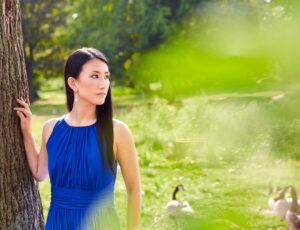 Grammy-Nominated soprano Aine Hakamatsuka is a versatile artist whose vocal flexibility and love for collaborative music-making have led her to a career spanning concert, opera, and choral repertoire.
Aine’s versatility is evident on the concert stage, where she has appeared as a soloist in repertoire ranging from the traditional to the contemporary. This season’s performances reach across the broad spectrum of her experience, from well-known masterpieces of Handel and Bach to the mesmerizing and provocative works of Steve Reich and Huang Ruo. In 2023, she joined the Clarion Choir and The English Concert on their tour performing Handel’s Solomon. She was also recently seen as the soprano soloist singing François Couperin’s Leçons de Ténèbres in concert at the historic St. Bartholomew’s Church in New York City. A champion of contemporary music, Aine has performed as a soloist in works by 20th and 21st century composers including David Lang, Katherine Hoover, and Thea Musgrave. Most notably, she was the soloist in the world premiere of Nina Shekhar’s Blush, a ten-minute long piece for soprano and choir that explores the sometimes painful, often beautiful experience of transforming from a girl into a woman.
A deep love of chamber music has inspired Aine to pursue a career that is full of both solo and ensemble singing. In demand as a choral artist, she is on the rosters of the esteemed Choir of Trinity Wall Street, Clarion Choir, and the Santa Fe Desert Chorale. She has appeared with Bach Vespers at Holy Trinity, Musica Sacra, the New York Philharmonic, New York Virtuoso Singers, and St. Bartholomew’s Choir, in prestigious venues such as the Barbican, Carnegie Hall, Lincoln Center, the Met Museum, and many of New York City’s most beloved churches.
Described by the Observer as a “pearly soprano” and by The New York Times as having “loads of personality,” Aine has made a mark performing soubrette and lyric coloratura opera roles including Lucy in The Telephone, Blonde in Die Entführung aus dem Serail, Madame Silberklang in Der Schauspieldirektor, Barbarina in Le nozze di Figaro, and Gretel in Hansel and Gretel, for which she was invited for a repeat performance at the Kennedy Center. When she is not performing, Aine enjoys caring for her two cats Mimi and Momo.
 Marisa Curcio is a soprano specializing in early music and small ensemble singing. Recent small ensemble work has included a performance celebrating Palestrina’s 500th with Res Facta through the Gotham Early Music Scene (GEMS), a performance of works by Bach and Gibbons with Music in the Somerset Hills (MISH), and a concert of works by Schubert, Schumann, and von Weber with Ensemble Altera and The Orchestra of St. Luke’s. Also of note was a performance of mandolinist Chris Thile’s work, ATTENTION! for Extroverted Mandolinist and Orchestra, with The Philadelphia Orchestra and Chris Thile. Marisa is on the roster of Amor Artis, through which she has most recently sung solo arias in David Lang’s Little Match Girl Passion, J. S. Bach’s Magnificat in D and Christmas Oratorio, and Purcell’s Hail! Bright Cecilia.
Marisa is a founding member of the Philadelphia-based choral collective, Convoco, which is in its fourth season. She is in her tenth season with the Philadelphia Symphonic Choir, the choir-in-residence for The Philadelphia Orchestra, and she looks forward to singing Händel’s Messiah with them again in December.
Marisa is active as a recitalist, and recent performances include Pergolesi’s Stabat Mater, a Lenten concert of works for soprano and harpsichord, and a Westminster Choir College alumni recital of works by Purcell and Monteverdi. A seasoned church musician, Marisa is a member of the professional choir at St. James’ Madison Avenue and the Lux Choir at The Episcopal Church at Princeton University (ECP). She is featured on the soon-to-be released album with the Lux Choir, A Fragment of the Immortal Air, on Affetto Records. Marisa holds degrees from Westminster Choir College, where she studied with Tom Faracco. She resides in northern New Jersey with her wife and their cat, Regina Caeli.
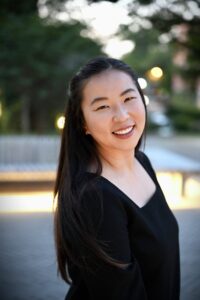 Eliana Barwinski is a versatile mezzo-soprano celebrated for her captivating performances and extensive musical expertise. A recent graduate of Yale University's Institute of Sacred Music and the University of Michigan, Ms. Barwinski is in her final year of doctoral studies in voice performance and historical performance from Indiana University’s Jacobs School of Music. Eliana's stage presence spans a variety of roles, from Tebro in O come e chiare e belle to alto soloist in Bach's Passions and large works, and has been showcased on both national and international stages. Her research encompasses early and sacred music, Central/Eastern European vocal repertoire, Chinese folk and art songs, and Anglican choral traditions. In addition to her compelling performances, Eliana is a dedicated educator and skilled arts administrator. Her teaching experience ranges from university guest lectures to private voice instruction. Eliana's ongoing journey serves as an inspiration as she contributes to the world of music through her artistry and commitment.
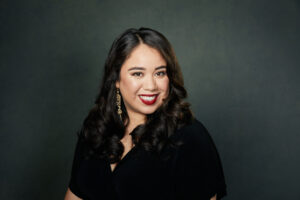 Mezzo-soprano Gabriela Estephanie Solís lends her "rich tone" and “moving expressiveness” (San Francisco Classical Voice) to an expansive range of concert repertoire spanning medieval through contemporary periods. As a passionate concert artist, her notable solo performances from past seasons include Copland’s In the Beginning (University of Notre Dame), Brahms’s Alto Rhapsody (Grace & St.Peter’s, Baltimore), selections from Mahler’s Rückert-Lieder (Berkeley Community Chorus and Orchestra), Mozart’s Requiem (Marin Symphony), and Holst’s The Cloud Messenger (The Epiphany Festival).
An avid interpreter of Baroque repertoire, she has collaborated with preeminent early music organizations such as Tempesta di Mare, Apollo’s Fire, American Bach Soloists, and the Boston Early Music Festival in performances including Vivaldi’s Juditha Triumphans (Tempesta di Mare), Bach’s B Minor Mass (Apollo’s Fire), Pergolesi’s Stabat Mater (Resonance Berkeley), Handel’s Messiah (Seraphic Fire), and Buxtehude’s Membra Jesu Nostri (University of Notre Dame), as well as on stage the roles of Medoro in Handel’s Orlando (BEMF Young Artist Training Program), Bradamante in Handel’s Alcina, and Endimione in Cavalli’s La Calisto at San Francisco State University. She also had the privilege of studying at the Weimar Bach Cantata Academy, Amherst Early Music Festival, and the Internationale Bachakademie Stuttgart.
In demand as an ensemble artist, she enjoys regular collaborations with groups such as Seraphic Fire, Lorelei Ensemble, and Apollo’s Fire. She competed as a finalist in both the 2022 Handel Aria Competition and the 2021 Audrey Rooney Bach Competition, won second place in the NATS mid-Atlantic regionals, and won first place in the 2018 Bethlehem Bach Aria Competition.
 Deemed an “impressive tenor” (The New York Times), Gene Stenger is a Bach specialist who is also heralded for his “crisp, clear tenor in action” (Washington Post) of his performances of oratorios by Handel, Haydn, Mendelssohn, and Mozart. He regularly performs with leading ensembles and interpreters of early music while continuing to expand his repertoire to include music of the 20th and 21st centuries.
Mr. Stenger’s 2025-26 season features solo engagements with Toledo Symphony (Handel’s Messiah), Portland Symphony (Bach’s Mass in B Minor), Princeton Pro Musica (Bach’s Magnificat), Bach Society of St. Louis (Mozart’s Requiem & Schubert’s Mass in G), Wisconsin Chamber Orchestra (Handel’s Messiah), Colorado Bach Ensemble (Handel’s Messiah & Bach’s St. John Passion), WindSync’s OnStage OffStage Chamber Music Festival (Mahler’s Das Lied von der Erde), Bach Collegium San Diego (BWV 106 & TVWV 4:17), Fifth Avenue Presbyterian Church NY (Bach’s St. John Passion), and Bach Vespers at Holy Trinity Lutheran NY (Schütz’s St. John Passion).
Equally at home in opera, Gene has performed with Opera LaFayette at the Kennedy Center, Teatro Nuovo at Lincoln Center, and premiered new works with both Odyssey Opera at Jordan Hall, and the Harvard University Choirs. In 2024, he received a jump-in offer from ResonanceWorks Pittsburgh to sing his first Rossini role in Rossini’s opera La donna del lago for which he was lauded by The Pittsburgh Tatler as “particularly stunning…. with a vibrant and powerful voice and a charismatic stage presence.” This Fall, he will be making his debut with Winter Opera St. Louis, performing the role of Alexis in Gilbert & Sullivan’s The Sorcerer.
Originally from Pittsburgh, Gene holds degrees from Yale University’s School of Music and Institute of Sacred Music, Colorado State University, and Baldwin Wallace University Conservatory of Music.
 Chicago-based oratorio tenor Steven Caldicott Wilson has been praised for his "limpid tenor, marked by wondrous phrasing and aching lyricism in 'Thy rebuke hath broken his heart’" (Chicago Classical Review) andhis “powerful, polished and moving Evangelist" (New York Times). He is thrilled to return to the Richardson stage with PPM, having sung the Evangelist role for their St. John Passion in 2023. Also in 2023, he returned to Carnegie Hall NYC for Messiah solos with Musica Sacra, and was a soloist for Gounod’s St. Cecelia Mass at Trinity Church Wall Street. He will sing chorus and solos in Messiah with DC’s The Thirteen in December 2025. From 2007—2012, he was a gentleman of the choir at St. Thomas 5th Avenue under the direction of the late John Scott.
Since 2011, Mr. Wilson has been a member of New York Polyphony, peerless among ensembles of its kind in the US. Their innovative programming spans Gregorian chant to contemporary commissions, and their focus on familiar and rare works of the 12-17th centuries has helped bring early music to modern audiences. Founded in 2006, the quartet’s discography includes two GRAMMY-nominated albums, and a new album Sky of my Heart released in June 2025 featuring works by Nico Muhly and many other living composers.
Steven has been a member of Boston's Handel + Haydn Society since 2015, and is a tenured member of Chicago's Grant Park Music Festival chorus. He is a veteran of the United States Air Force Band Singing Sergeants and a graduate of Ithaca College (BM) and Yale University (MM). scwtenor.com
 Lauded for his “sonorous” voice (Opera News), American baritone Harrison Hintzsche is celebrated for his warm lyric tone, nuanced musicality, and profound dedication to text. His dynamic career spans oratorio, art song, and chamber music, where he thrives on the challenge of interpreting a diverse repertoire and bridging a living connection between author and audience.
Hintzsche’s passion for music has led him to perform on world-class stages such as London’s Wigmore Hall, New York City’s Weill Recital Hall and Alice Tully Hall, and Seoul’s National Theater of Korea. He has worked closely with several celebrated leaders in music, such as Nicolas McGegan, Masaaki Suzuki, Graham Johnson, and Jos van Veldhoven.
Recent performance highlights include Bach’s St. Matthew Passion with Kent Tritle at the Cathedral of St. John the Divine; Bach’s Magnificat with Jos van Veldhoven and the Oregon Bach Festival Chorus, as well as with Matthew Dirst and the Portland Baroque Orchestra; Bach’s bass solo cantatas Ich habe genug and Ich will den Kreuzstab gerne tragen with Philip Cave and Duke University; and Finzi’s In Terra Pax and Vaughan Williams’s Fantasia on Christmas Carols with the Choral Society of the Hamptons. He has recorded the bass arias in J. S. Bach’s St. John Passion, Easter Oratorio, Magnificat, and the soon-to-be-released St. Matthew Passion with Cantata Collective and conductor Nicholas McGegan, all released by AVIE Records.
A sought-after ensemble musician, Hintzsche has performed with some of the nation’s leading choral ensembles, including the Santa Fe Desert Chorale, Conspirare, Ensemble Altera, the Oregon Bach Festival Chorus, the Leonids, True Concord Voices & Orchestra, Yale Choral Artists, and the VocalEssence Ensemble Singers, among others. He holds degrees in music from Yale University and St. Olaf College. Hintzsche is currently based in Brooklyn, New York, and hails from DeKalb, Illinois. www.harrisonhintzsche.com.
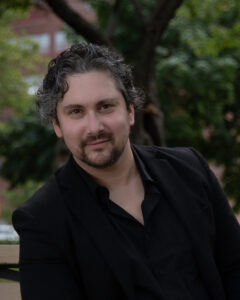 Baritone Will Berman (he/him) is a versatile interpreter of vocal music, with a passion for art song and a commitment to highlighting LGBTQIA+ composers.
Berman has appeared as a soloist in major choral-orchestral works including Brahms’ Ein deutsches Requiem and Orff’s Carmina Burana, the latter praised by Out in New Jersey Magazine for his “good voice” in a performance with Princeton Pro Musica. He has also brought to life Mahler’s Rückert-Lieder, Cipullo’s Another Reason Why I Don’t Keep a Gun in the House, and Poulenc’s Banalités. His doctoral lecture recital examined Schubert’s Die Winterreise, uniting performance and scholarship.
On the operatic stage, Berman is recognized for vivid characterizations and vocal flexibility. Favorite roles include Papageno in Die Zauberflöte, Harlekin in Ariadne auf Naxos, the Count in Le nozze di Figaro, and Samuel in The Pirates of Penzance. His performances emphasize clarity of text and emotional honesty.
A frequent recitalist, Berman has performed across the United States and Europe, curating programs that combine classical repertoire with contemporary and underrepresented voices. He is a regular member of the choir at the Church of St. Luke in the Fields in New York City, where he also appears as a soloist in their renowned concert series.
Originally from Westchester, New York, Berman earned a Doctor of Musical Arts degree from Rutgers University, a Master of Music from Westminster Choir College, and a Bachelor of Music from the Eastman School of Music. His lifelong mentor is retired Metropolitan Opera soprano Sharon Sweet.
He lives in Hoboken, New Jersey with his husband, Ryan, and their dog, Powder, and enjoys cooking and making craft cocktails.
 Originally from Tokyo, Japan and now based in New York, NY, Kako Miura is a violinist who performs on both historical and modern instruments. She is the recipient of numerous awards, including first prize in the Nagano International Music Festival Violin Competition, Bergen Philharmonic Orchestra’s Young Artists Competition, and Sound Symphony Orchestra’s Solo Competition, as well as a National YoungArts Foundation Award.
Kako has appeared internationally as a soloist, performing concertos alongside orchestras in Asia, Australia, and the United States, and her solo and chamber music performances have taken her to such distinguished venues as Alice Tully Hall of Lincoln Center, Weill and Zankel Halls at Carnegie Hall, and the Sydney Opera House.
Deeply committed to community engagement and music education, Kako has worked extensively with the Music Advancement Program, a department of The Juilliard School’s Preparatory Division, o1ering instruction on violin as well as courses on historical performance and curricular studies. In 2019, she conceived, directed, and performed an original interactive concert centered around Baroque music for local elementary school students in New York City, titled A Day in the Life of a King, as part of The Juilliard School’s Young People’s Concerts series.
Kako currently studies at The Juilliard School, pursuing a graduate degree in Historical Performance under the guidance of Cynthia Roberts, Elizabeth Blumenstock, and Robert Mealy. She holds a Bachelor of Music degree from The Juilliard School, where she also attended the Pre-College program, as well as a Master of Music from The Colburn School. Her principal teachers have included Robert Lipsett and Masao Kawasaki.
Kako plays a Vuillaume workshop “St. Cecile des Thernes” violin and Sartory bow, generously on loan from the Nippon Violin Company, as well as a Kloz Baroque violin and several period bows from the Juilliard Instrument Collection. In addition to music, Kako loves food, tea, and naps.
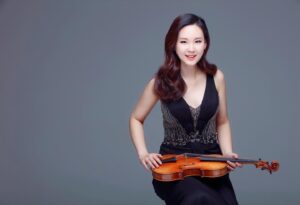 NYC-based violinist Isabelle Seula Lee regularly performs throughout the US, Europe, and Asia
at major venues, and has established a reputation for her versatility and fluency across a wide
range of musical styles.
She began studying the violin at age four in South Korea before moving with her family to
Russia, where she spent ten years at the Special Music School of the Saint Petersburg Conservatory. At age eleven, she made her debut as a concerto soloist with the Tele-Radio
Symphony Orchestra in Saint Petersburg, and later appeared as soloist with the Saint
Petersburg State Symphony Orchestra, the Saint Petersburg Conservatory Symphony, the
Chamber Orchestra of Estonia, and the Lynn Philharmonia.
As a baroque violin soloist, Isabelle has appeared with New York Baroque Incorporated, the
Sebastians, Philharmonia Baroque Chamber Players, Voices of Music, and Juilliard415.
Isabelle is currently among the leading musicians of Philharmonia Baroque Orchestra in San
Francisco, where she has appeared as concertmaster under Richard Egarr in California, as well
as at the Tanglewood and Caramoor festivals. She also frequently performs with other
ensembles throughout US and internationally, including Bach Collegium Japan, New York
Baroque Incorporated, the Sebastians, Trinity Baroque Orchestra, and Voices of Music.
As a soloist, and chamber musician, Isabelle has collaborated with early music specialists such
as Richard Egarr, Monica Huggett, Lars Ulrik Mortensen, Rachel Podger, and Masaaki Suzuki.
Isabelle holds degrees from Lynn University (B.A.), The Juilliard School (M.M. in modern and
baroque violin), and the Yale School of Music (Artist Diploma) where her teachers included
Elmar Oliveira, Hyo Kang, Naoko Tanaka on modern violin, and Robert Mealy, Monica Huggett,
Cynthia Roberts, Rachel Podger and Elizabeth Blumenstock on the baroque studies.
Source: bach-cantatas.com
| 1.
Singet dem Herrn ein neues Lied, |
Sing to the Lord a new song, |
| CHORALE (CHOR II); ARIA (CHOR I)
Wie sich ein Vater erbarmet |
(chorale is shown in bold text)
Just as a father has compassion |
| 3.
Lobet den Herrn in seinen Taten, |
Praise the Lord for his acts, |
Magnificat in D Major, BWV 243
Text from Luke 1: 46-55
- Chorus
Magnificat anima mea Dominum.
My soul proclaims the greatness of the Lord.
- Aria, Soprano II
Et exsultavit spiritus meus in Deo salutari meo
and my spirit has exulted in God my saviour.
- Aria, Soprano I
Quia respexit humilitatem ancillae suae;
because he has regarded the lowly state of his slavegirl;
ecce enim ex hoc beatam me dicent
for look! from now on [they]will say that I am blessed
- Chorus
Omnes generationes.
every generation.
- Aria, Bass
Quia fecit mihi magna qui potens est, et sanctum nomen eius.
because he who is mighty has done great things for me, and holy is his name.
- Duet, Alto and Tenor
Et misericordia a progenie in progenies timentibus eum.
and his mercy [continues ] from generation to generation for those who fear him.
- Chorus
Fecit potentiam in brachio suo, dispersit superbos mente cordis sui.
He has made known the power of his arm, scattered those who are arrogant in the thoughts of their heart.
- Aria, Tenor
Deposuit potentes de sede et exaltavit humiles.
He has put down the mighty from their seats [of power] and raised up those who are lowly.
- Aria, Alto
Esurientes implevit bonis et divites dimisit inanes.
The hungry he has filled with good things, and the rich he has sent away empty.
- Trio, Soprano I and II, Alto
Suscepit Israel puerum suum recordatus misericordiae suae.
He has taken under his protection Israel his boy, and remembered his mercy.
- Chorus
Sicut locutus est ad Patres nostros,
in accordance with what he said to our fathers,
Abraham et semini eius in saecula.
to Abraham and to his seed for ever.
- Chorus
Gloria Patri, gloria Filio,
Glory to the Father, glory to the Son
gloria et Spiritui Sancto!
glory also to the Holy Spirit!
Sicut erat in principio et nunc et semper
As it was in the beginning and [is] now and always
et in saecula saeculorum.
and throughout ages of ages.
Amen.
Dona Nobis Pacem
Mass in B Minor, Mvmt. 27
Dona nobis pacem.
Grant us peace.
| SOPRANO
Gail Balog |
ALTO
LaVerna Albury |
| TENOR
Timothy Carpenter |
BASS
Max Brey |
New York Baroque, Incorporated
| Violin Kako Miura violin solo Mandy Wolman Rebecca Nelson Lydia Becker Violin II Viola Cello Bass
|
Flute David Ross Mei Stone Oboe Bassoon Trumpet Timpani Keyboard |
A very special thank you to the staff and crew of Richardson Auditorium in Alexander Hall, Princeton University for all your help.
Princeton Pro Musica wishes to thank the following individuals and organizations for providing their assistance and support:
Discover Jersey Arts
Innvoke Print and Marketing Solutions
Princeton Area Community Foundation
Princeton Mercer Chamber of Commerce
Regina Opera Company for their Supertitles template
VOLUNTEER COORDINATOR
Janet Breslin
AUDITIONS COORDINATOR
Janet Perkins
BOOKKEEPER
Maureen Kyle
CHAMBER CHORUS COORDINATORS
Susan Bindig
Carolyn Landis
CONCERT HOUSE STAFF
Kitanya Khateri
Kevin Dziuba
CONCERT MANAGER
Dianne D. Miles
DIGITAL PROGRAM
Dianne D. Miles
MUSIC COORDINATOR
Sara Maldonado
OFFICE ASSISTANT
Janet Perkins
OUTREACH COORDINATOR
Nina Lucas
REHEARSAL COORDINATOR
Janet Breslin
SECTION LEADERS
Candus Hedberg, soprano
Kim Neighbor, alto
Gary Gregg, tenor
Devon Grant, bass
SUPERTITLES CREATOR/OPERATOR
Mary Trigg
WEBMASTER
Kenny Litvack
Related Events