Freedom Writers
Freedom Writers
March 15, 2026
Pre-concert talk, 3 p.m.
Concert, 4 p.m.
Richardson Auditorium
Princeton University
Freedom Writers
March 15, 2026
Pre-concert talk, 3 p.m.
Concert, 4 p.m.
Richardson Auditorium
Princeton University
This year marks 250 years since the creation of The United States of America with the Declaration of Independence. A hallmark occasion like this–a quarter of a millennium!–naturally invites some reflection. What is this thing, the United States of America? How did we make it to this point? Where are we heading?
Caught up in the demands of our day to day lives, or spinning in the whir of ever-shorter news cycles, it can be easy to lose sight of just how momentous, novel, and radical it was in 1776 to declare independence and found a democratic republic. The founders declared the existence of “The United States of America.” In doing so, they didn’t forge a permanent, physical entity. The country’s geographical bounds have changed many times. And in doing so, they didn’t immediately establish an effective system of government. The Declaration was just the beginning. When delegates convened some ten years after the founding to draft a Constitution, they debated ideas and ideals, some ancient, some novel. They wheeled and dealed in search of consensus. While the convention produced a constitution, they were under no illusions that it was a fait accompli, that they were in total agreement, or that they had made something infallible, something that wasn’t besmirched by dehumanizing compromises and half measures. Some 40 of the 56 signers of the Declaration of Independence owned or had owned enslaved people. Somewhere between 17 and 25 of the 55 delegates to the Constitutional convention were enslavers. None were women.
Indeed, in the preamble, they declare that they’re striving to make a “more perfect” union, improving on the articles of confederation, but not achieving perfection itself. Union implies coming together. Plurality is baked right into our name, the United States. The nation is a notion, a framework. They, like us, were juggling the tangible, quotidian realities of living in this new nation–taxes, rights, elections, security–with the bigger ideals that held it all together. The survival of their experiment has required our navigating two pulls, sometimes entwined, sometimes at odds: the continual adaptation to unforeseen quotidian realities and a devotion to the best parts of its foundational principles.
We’re taking the occasion, this afternoon, not to blow out birthday candles, pat ourselves on the back for a job well done, or wag our fingers at past wrongs, but to consider, briefly through music, how a few American figures have considered American freedom in seminal writings. The texts that inspired the music on today’s program come from several key points in the formation and re-formation of our nation. They interrogate inclusion and equity. They warn against tyranny–a word that, for a while, at least, felt quaint, historical, but once again feels urgent. They express hope.
The earliest writer featured is Abigail Adams. Julia Wolfe’s Letter from Abigail sets an excerpt from one of her many letters to her husband, John Adams. In the spring of 1776, John was in Philadelphia in the hopes of making a daring, radical rupture with Britain. In a letter to him, Abigail admits that the concurrence of spring and the departure of the British fleet from Boston had left her with an unusual “gaiety de coeur.” She told John she longed to hear of “an independency” and took the occasion to express:
"-and by the way in the new code of laws which I suppose it will be necessary for you to make, I desire you would remember the ladies, and be more favorable to them than your ancestors. Do not put such unlimited power into the hands of husbands."
She then borrows a line from a poem by Daniel Defoe: “Remember all men would be tyrants if they could” and continues:
If particular care and attention is not paid to the ladies we are determined to foment a rebellion, and will not hold ourselves bound by any laws in which we have no voice or representation. That your sex are naturally tyrannical is a truth so thoroughly established as to admit of no dispute, but such of yours as wish to be happy willingly give up the harsh title of master for the more tender and endearing one of friend. Why then not put it out of the power of the vicious and the lawless to use us with cruelty and indignity with impunity. Men of sense in all ages abhor those customs which treat us only as vassals of your sex.
The historian David McCullough suggests that Abigail was, in part, joking. But–he clarifies–only in part. The nature of rulers and the contours of leadership were very much on the minds of those adjacent to and in-the-room with the formation of this new nation and its laws. Some essential notion in Abigail Adams’s heart is reflected, in part, by James Madison’s pithy observation in the 51st Federalist Paper that “If men were angels, no government would be necessary.” And while John Adams partially dismissed Abigail’s plea, others heard it loudly and clearly. Her demand was considered by many in the women’s suffrage movement in the 19th century to be the opening salvo, declared in the same year independence itself was declared. Women wouldn’t gain the right to vote, of course, until the 19th amendment to the Constitution was ratified 144 years later.
Composed in 2019, the work is part of Wolfe’s ongoing engagement with American texts and the lives that surround them. Other projects have included pieces about Pennsylvania coal country, the Triangle Shirtwaist company fire, and the suffrage movement. In Letter from Abigail, Wolfe takes this brief but electrifying fragment of American history, puts it into the mouths of singers, and turns it into something vivid and immediate: a musical setting that amplifies Abigail’s clarity, urgency, and quiet fury. She breaks apart Adams’s sentences into their components, stopping, circling on individual words, pairs of words, allowing the listener time to meditate on each. The music gathers force around the words—at times insistent, at times luminous—so that the listener hears both the historical moment and its unfinished implications.
Throughout, she explores the coloristic possibilities of the voice, from clipped, speechlike utterances to dreamy sighs to shouts. She likewise calls on a wide array of colors and techniques from the string orchestra and percussion section. At the climax of the piece, “remember all men would be tyrants,” she instructs the sopranos and altos to whisper. Wolfe knowingly excerpts just the four words “we have no voice” from the phrase “will not hold ourselves bound by any laws in which we have no voice.” Her background in theater often inspires her to include theatrical instructions in her music, and, in Letter from Abigail, instructs singers to cover their mouths with their hands, physicalizing this central point.
Her ending makes the point explicit. She notes: “You can end in so many different ways. It can be triumphant. How many of us have been in orchestra concerts where it ends like ‘ka-chang!’ and everyone’s [applauding]. I’m really fascinated by endings. All ways of ending are valid and it really depends on the piece but I liked the idea of it being choked at the end.” Abigail Adams’s voice, via Wolfe’s music, powerfully reminds us that the question of equity between two halves of the nation’s population has been present since its founding, and that throughout the nation’s 250-year existence, millions of its voices have been silenced, unheard.
Today we’re going to perform a brand new arrangement, for chorus and orchestra, of a piece written by our principal oboist, Sarah Davol, on Emma Lazarus’s sonnet, A New Colossus, cast on the base of the statue of liberty.
In the early 1880s, waves of Jews fled violent pogroms in the Russian Empire and arrived in New York, bewildered and destitute. Emma Lazarus—wealthy, cultured, and until then somewhat insulated—encountered these newcomers directly. Their plight unsettled her. It pushed her toward a new sense of Jewish solidarity and moral responsibility. When asked to contribute a poem to help fund the Statue of Liberty’s pedestal, she initially refused. After friends urged her to imagine the statue as the first sight greeting immigrants entering New York Harbor, she agreed. Hers are words of welcome.
“Give me your tired, your poor,
Your huddled masses yearning to breathe free,
The wretched refuse of your teeming shore.
Send these, the homeless, tempest-tost to me,
I lift my lamp beside the golden door!”
The sonnet translates the experience of those refugees–their exhaustion, their hope—into a bigger story. The statue is not a monument, but a “mother of exiles,” a voice for the displaced arriving at America’s shore. This experimental “America,” at its founding, was populated by people who had themselves or whose parents and grandparents had come from another country, and the people some of them enslaved. Throughout her history, America’s “golden door” has swung open and been yanked shut, but people finding their way here, seeking opportunity, has always been a part of her story.
Davol’s melody captures this optimism – I lift my lamp, with upward sweep. It also captures the downtrodden quality of the wretched refuse with downward melodic gestures. At its core is a shift from darkness to light. My arrangement opens with a fanfare – the dream of the American arrival – and the chorus singing the melody twice. The middle section of the piece is a fantasia on its principle melodic ideas, and its shifts from the fear, rocking in the boat, crossing the Atlantic, to glimmers of the optimism that fueled the journey. Eventually, we reach a tranquillo—a calm ocean on the dawn of the arrival at New York Harbor. The imagined sight of the statue on the horizon stirs up the opening fanfare, and the piece builds to a triumphant close.
Aaron Copland’s Lincoln Portrait of 1942 was born at a moment when the United States and its European allies were again asking if democratic nations could endure. In the early months of American involvement in World War II, conductor André Kostelanetz asked several composers to write orchestral works that might speak to the nation’s ideals.
After initially considering Whitman as a subject, Copland turned instead to Abraham Lincoln. He seems to have wanted to portray Lincoln not as a monument, but as a voice in the midst of crisis. He determined that music alone was insufficient, and added a role for a narrator. The texts he selected for the narrator come from three moments between 1858 and 1863—years when the United States came as close as it ever has to ceasing to exist. The words move between an address to congress and a speech given in 1858, and culminate in the Gettysburg Address of 1863. Rather than constructing a biography, Copland assembled fragments that trace an arc: from a nation confronting division to a people asked to measure themselves against their founding ideals.
With respect to the music, Copland said he “hoped to suggest something of the mysterious sense of fatality that surrounds Lincoln's personality. The challenge was to compose something simple, yet interesting enough to fit Lincoln." He opens with a simple dotted-note figure, quietly, shared between a flute and a muted trumpet, establishing at the outset the coexistence of the softest and most bellicose voices. Copland ruminates on this simple gesture incessantly, alternating between quiet reflection and ceremonial grandeur, barely audible inner thoughts, and impassioned outcries. The music surrounding this motif is representative of Copland’s now-iconic American sound—wide intervals, open textures, and quotations of folk tunes such as “Camptown Races” and “Springfield Mountain.”
A narrator enters in the third section of the piece. Copland’s music isn’t meant to interpret or soundtrack the words; in a note for the narrator in the score, he advises: “the words are sufficiently dramatic in themselves.” What gives Lincoln Portrait its enduring power is that the text refuses to resolve the tension at the heart of the American project. Lincoln speaks repeatedly of unfinished work: of a nation “dedicated to the proposition that all men are created equal,” and of the responsibility to ensure that “government of the people, by the people, for the people shall not perish from the earth.” These are not declarations of accomplishment but an urgent voice, from a time when the nation was gravely imperiled, bidding us “take increased devotion to that cause.”
Howard Hanson’s Song of Democracy, appeared 15 years after Copland’s Portrait, in 1957. Hanson sets two late poems by Walt Whitman—an old poet looking back on youth and forward toward the nation’s uncertain future. The work was written for the centennial of the National Education Association and the fiftieth anniversary of the Music Educators National Conference, and Hanson himself led its premiere in Washington, D.C., before an audience of some 23,000.
That origin story is apt. Hanson was not only a composer but one of the great advocates for American music education, shaping generations of musicians during his four decades as director of the Eastman School of Music. The commission gave him an opportunity to unite two of his deepest loyalties: Whitman’s poetry and the idea that the future of democracy rests, quite literally, in the classroom.
Whitman’s text comes from the elder poet of the Reconstruction era—no longer the young radical of Leaves of Grass, but a man who had seen civil war and national fracture and perhaps had hope in the educational aspect of the Reconstruction project. The first section, “An Old Man’s Thought of School,” was written for the dedication of a new public school in Camden, NJ, in 1874. The rousing final section, “Sail thy best, ship of democracy,” comes from the poem “As a Strong Bird on Pinions Free,” recited at the Dartmouth College commencement in 1872. Whitman imagines democracy as a ship moving through history, carrying not only America but the accumulated struggles and ideals of the world. Its cargo is youth: “these young lives… building, equipping, like a fleet of ships.” The humble public school becomes the place where that voyage is prepared.
Hanson answers Whitman’s vision in unmistakably American musical language—broad, luminous, and unabashedly idealistic. The work unfolds as a choral hymn to possibility, fusing Whitman’s expansive poetry with Hanson’s neo-Romantic lyricism. What makes the piece striking today is the vantage point from which Whitman speaks. Writing late in life, amid the unfinished promises of Reconstruction, he nevertheless entrusts the nation’s future to its youngest citizens and to the teachers who shape them. The “ship of Democracy,” Whitman suggests, does not sail on rhetoric or power alone—but on the patient labor of public education, preparing each new generation for the voyage ahead.
Aaron Copland’s Fanfare for the Common Man was written in 1942, at the request of conductor Eugene Goossens of the Cincinnati Symphony Orchestra. Goossens had the idea—amid the uncertainty of World War II—to commission a series of short fanfares honoring the spirit of the American people. Copland chose his title after reading a speech by Vice President Henry Wallace, who proclaimed the coming century “the century of the common man.” Scored for brass and percussion alone, the work unfolds in spacious but solid gestures. The percussion section opens the work with a tectonic quake. Unison trumpets soar across wide intervals, joined at the repeat by a quartet of unison horns. Trombones and tubas blaze.
There’s something brazen, or at least ironic, about the title. For centuries, fanfares were the provenance of royalty, aristocrats, victors. The semiotics–brass, dotted rhythms–connote regality, class hierarchy. The creator of this fanfare for the “common man,” one of the most enduring sonic emblems of American plainspoken heroism, was anything but “common” as the term would have been understood in the 1940s, on the eve of two decades or so of astonishingly pervasive hegemony. He was a gay, Jewish composer from Brooklyn, formed by modernist training in Paris and by intellectual circles far removed from the agrarian mythologies often attached to his music.
Maybe that distance is why the piece works. Copland chose the title himself, and in so doing elevates “common” from its pejorative sense to its connotation of universal. Copland didn’t try to imitate everyday life, the way he did in other pieces; he distilled an idea of dignity—broad, deliberate, and unadorned. The result is less a portrait of ordinary Americans than a monument to the ideal they were asked, in wartime, to become. Harmonically, the work chooses aspiration over closure: The F sharps in its final, radiant D major chord brighten, and leave behind, the prevailing Bb major sonority.
Taken together, these works trace a lineage of American self-definition. They remind us that democracy is not a static inheritance but an ongoing act of imagination—one that each generation must undertake again. Copland’s Lincoln Portrait listens back to a moment when the nation nearly fractured beyond repair. In doing so, it asks the same question Lincoln asked in his own time: whether the ideals that gave the country birth can continue to guide it forward.
We never know, when we program a concert (typically at least a year and a half in advance) how we’ll feel when the day finally arrives. We’re not in the midst of a Civil War, of course, or World War II. Though we are at war. And the questions implied in that initial Declaration are still being raised. This coming summer, there will surely be speeches and celebrations considering the Declaration made on July 4.
Last summer on July 5, our sitting Vice President gave a speech in which he said “If you think about it, identifying America just with agreeing with the principles of the Declaration of Independence–that’s a definition that is way over-inclusive and under-inclusive at the same time. What do I mean by that? Well, first of all, it would include hundreds of millions, maybe billions of foreign citizens who agree with the principles of the Declaration of Independence. Must we admit all of them tomorrow? It would also reject a lot of people the Anti-Defamation League would label as domestic extremists . . even those very Americans . . .[who] had their ancestors fight in the Revolutionary and the Civil War. . . I think the people whose ancestors fought in the Civil War have a hell of a lot more claim over America than the people who say they don’t belong.” Vance praised the contributions of immigrants while noting that they needed to be grateful. He mentioned in particular Zohran Mamdani, an immigrant, then a candidate for and now mayor of New York City, who had described America the day before, July 4th, as “beautiful, contradictory, unfinished.” Vance pondered: “Has he ever looked in the mirror and recognized that he might not be alive were it not for the generosity of a country he dares to insult on its most sacred day?
In a way, Vance’s speech is in dialogue with a speech Lincoln gave in 1858 considering the Dred Scott decision, slavery, and the question of popular sovereignty. Lincoln said:
We have besides these men — descended by blood from our ancestors — among us perhaps half our people who are not descendants at all of these men, they are men who have come from Europe — German, Irish, French and Scandinavian — men that have come from Europe themselves or whose ancestors have come hither and settled here, finding themselves our equals in all things. If they look back through this history to trace their connection with those days by blood, they find they have none, they cannot carry themselves back into that glorious epoch and make themselves feel that they are part of us, but when they look through that old Declaration of Independence, they find that those old men say that “we hold these truths to be self-evident, that all men are created equal,” and then they feel that that moral sentiment taught in that day evidences their relation to those men, that it is the father of all moral principle in them and that they have a right to claim it as though they were blood of the blood and flesh of the flesh of the men who wrote that Declaration, and so they are. That is the electric cord in that Declaration that links the hearts of patriotic and liberty-loving men together, that will link those patriotic hearts as long as the love of freedom exists in the minds of men throughout the world.
It remains valuable to debate and consider our founding ideals, and endeavor to set the best course for our “ship of democracy.” But how? Historical documents are inert. Ideals take no actions. We live with and amongst each other. That’s where our concert comes in.
The French writer and observer of early America, Alexis de Tocqueville, captured a particular essence of the American spirit, as it was lived, in his 1835 Democracy in America. DeTocqueville’s home country had experienced a revolution around the same time as America had, though theirs ended differently. He sought to understand how that came to be. He identified something special in America’s local democracy, at the state, town, and civic level, noting that “township institutions” “give people the taste for freedom and the art of being free.” He observed that Americans formed what he called “associations:”
Not only do [Americans] have commercial and industrial associations in which all take part, but they also have a thousand other kinds: religious, moral, grave, futile, very general and very particular, immense and very small; Americans use associations to give fêtes, to found seminaries, to build inns, to raise churches, to distribute books, to send missionaries to the antipodes; in this manner they create hospitals, prisons, schools … Everywhere that, at the head of a new undertaking, you see the government in France and a great lord in England, count on it that you will perceive an association in the United States.
To de Tocqueville, these associations wove the individual threads of humanity into a tapestry–a citizenry, a society. Some of America’s founding principles came from philosophical debates in French salons but, Frenchmen felt no deep link to each other. Americans, though, in his mind, behaved differently. “As soon as several of the inhabitants of the United States have conceived a sentiment or an idea that they want to produce in the world, they seek each other out; and when they have found each other, they unite.” The threads start to weave together.
And where are we now? Is this still true? I fear that we no longer “associate.” We “engage,” alone. A description, now five years old, by The Atlantic’s Anne Appelbaum and Peter Pomerantsev, has stuck with me:
As internet platforms allow Americans to experience the world through a lonely, personalized lens, this problem has morphed into something altogether different. With the wholesale transfer of so much entertainment, social interaction, education, commerce, and politics from the real world to the virtual world—a process recently accelerated by the coronavirus pandemic—many Americans have come to live in a nightmarish inversion of the Tocquevillian dream, a new sort of wilderness. Many modern Americans now seek camaraderie online, in a world defined not by friendship but by anomie and alienation. Instead of participating in civic organizations that give them a sense of community as well as practical experience in tolerance and consensus-building, Americans join internet mobs, in which they are submerged in the logic of the crowd, clicking Like or Share and then moving on. Instead of entering a real-life public square, they drift anonymously into digital spaces where they rarely meet opponents; when they do, it is only to vilify them.
And more has changed in the five years since those words were written. Though its effect in our day-to-day lives might still be, at least as far as our perception is concerned, subrasa, AI stands to change the way society grapples with information, interacts with, and understands itself. Already un-real video harbors the capacity to rend societies in two, in a way we haven’t seen, perhaps, since the 1850s.
What more potent antipode to this disintegration could there be than a moment such as the one we’re creating, this afternoon? We have put in hours and hours of rehearsal. You have purchased a ticket. To what end? To listen. To see and hear and feel what happens when human beings breathe, and sing and blow and beat and bow, not willy-nilly, but in dogged, cooperative, selfless coordination and consensus. This is neither theoretical nor artificial. Our Princeton Pro Musica community is an association.
To be sure, our occasion today is nowhere near as serious as Lincoln’s, dedicating the Gettysburg cemetery in 1863. But this concert shares Lincoln’s spirit of looking back and looking forward. He admits that they were, nominally, gathered to do just one thing–dedicate a cemetery. “But” he continues, “in the larger sense, we can not. . . .It is for us the living, rather, to be dedicated here to the unfinished work which they who fought here have thus far so nobly advanced. It is rather for us to be here dedicated to the great task remaining before us -- that from these honored dead we take increased devotion to that cause for which they gave the last full measure of devotion.” As we head into a summer of celebration and reflection, I hope that the words and music on today’s program help create for you a space for pride, for contemplation and, above all, for increased devotion. Thank you for being here.
Fanfare for the Common Man, Aaron Copland (1900-1990)
Letter from Abigail, Julia Wolfe (b. 1958)
American Statue, Sarah Davol, arr. Ryan J. Brandau
Intermission
America the Beautiful, Samuel Ward (1848-1903), arr. Philip Rothman
Lincoln Portrait, Aaron Copland
Sally Chrisman, Angel Gardner, Bernard McMullan, narrators
Song of Democracy, Howard Hanson (1896-1981)
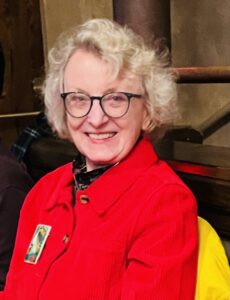 Sally Chrisman, soprano, has been singing with Princeton Pro Musica since 2000, and has performed with numerous choral and musical theater ensembles since her first church choir in childhood. Now retired from her career as a middle school English teacher, she has time for her other passions: visiting art museums and galleries; reading and discussing fiction and non-fiction in several book groups; and volunteering at the Princeton Public Library as an English-language conversation partner. Sally and her husband, Richard Chrisman, pursue many additional cultural interests together, and they also enjoy traveling and sharing their love of the arts with their grandchildren.
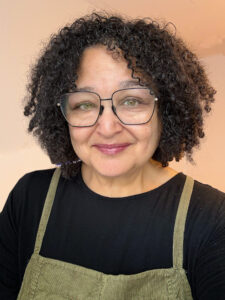 Angel Gardner has been a member of the soprano section of Princeton Pro Musica since 2015. Prior to joining Pro Musica, she lived in New York City and sang with the Oratorio Society of New York and the Choir of the Cathedral Church of St. John the Divine. Other choral credits include The Planets, Bernstein Mass, and Philharmonic 360 with the New York Philharmonic; and Tosca with the Princeton Festival.
Angel performed for almost two decades in Ping Chong & Company’s interview-based Undesirable Elements series, first as part of the NYC cast at Henry Street Settlement, Museum of Natural History, SUNY Stoneybrook, Art Awareness; with the 10th Anniversary (UE/02) cast at LaMama ETC, Lille Capital of Culture Festival, Romaeuropa Festival, Colorado Festival of World Theatre, Williams Center for the Arts; and finally in a special 20th Anniversary performance at The Green Space in New York City broadcast live on WQXR. Other acting credits include The Hobbit, Y2K Xmas, Hair (Yale Cabaret), A Christmas Carol, The White Liars (Goshen College Players).
An arts administrator for more than 30 years, Angel currently serves as Associate Director, External Affairs with Princeton University’s Peter B. Lewis Center for the Arts.
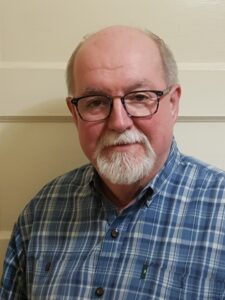 Bernard McMullan has sung with Princeton Pro Musica for more than 30 seasons. He also performs with PPM’s chamber chorus; is a member of the a cappella ensemble, Mostly Motets; and sings with the Absalom Jones Inspirational Choir of Trinity Episcopal Cathedral. A Trenton resident, Bernard is active in numerous community improvement, historic and cultural organizations in the capital city. He and his spouse, Sam Stephens, live in the Island community along the banks of the Delaware River. They are joined in that neighborhood by three adult children, their spouses, and five grandchildren.
Still engaged as an independent evaluator of educational and social service initiatives, Bernard earned a doctorate in sociology at Indiana University, Bloomington.
Letter from Abigail
Text by Abigail Adams
Music by Julia Wolfe
Dear John,
I desire you would remember the ladies
And be more generous and more favorable than our ancestors.
Do not put such unlimited power into the hands of husbands.
Remember all men would be tyrants if they could.
We will foment a rebellion.
We have no voice.
To read the full text of the letter, click here. [Source: Massachusetts Historical Society]
American Statue
Excerpted from "The New Colossus"
Text by Emma Lazarus
Music by Sarah Davol
Give me your tired, your poor,
Your huddled masses yearning to breathe free,
The wretched refuse of your teeming shore.
Send these, the homeless, tempest-tost to me,
I lift my lamp beside the golden door!
To read the full text of the poem, click here. [Source: Poetry Foundation]
America the Beautiful
Text by Katharine Lee Bates
Music by Samuel A. Ward
O beautiful for spacious skies,
For amber waves of grain,
For purple mountain majesties
Above the fruited plain!
America! America!
God shed His grace on thee
And crown thy good with brotherhood
From sea to shining sea!
O beautiful for patriot dream
That sees beyond the years
Thine alabaster cities gleam
Undimmed by human tears!
America! America!
God shed His grace on thee
And crown thy good with brotherhood
From sea to shining sea!
Lincoln Portrait
Texts excerpted by speeches of Abraham Lincoln
Music by Aaron Copland
"Fellow citizens, we cannot escape history."
That is what he said. That is what Abraham Lincoln said.
"Fellow citizens, we cannot escape history. We of this congress and this administration will be remembered in spite of ourselves. No personal significance or insignificance can spare one or another of us. The fiery trial through which we pass will light us down in honor or dishonor to the latest generation. We, even we here, hold the power and bear the responsibility." [Annual Message to Congress, 1 December 1862]
He was born in Kentucky, raised in Indiana, and lived in Illinois. And this is what he said. This is what Abe Lincoln said.
"The dogmas of the quiet past are inadequate to the stormy present. The occasion is piled high with difficulty and we must rise with the occasion. As our case is new, so we must think anew and act anew. We must disenthrall ourselves and then we will save our country." [Annual Message to Congress, 1 December 1862]
When standing erect he was six feet four inches tall, and this is what he said.
He said: "It is the eternal struggle between two principles, right and wrong, throughout the world. It is the same spirit that says 'you toil and work and earn bread, and I'll eat it.' No matter in what shape it comes, whether from the mouth of a king who seeks to bestride the people of his own nation, and live by the fruit of their labor, or from one race of men as an apology for enslaving another race, it is the same tyrannical principle." [Lincoln-Douglas debates, 15 October 1858]
Lincoln was a quiet man. Abe Lincoln was a quiet and a melancholy man. But when he spoke of democracy, this is what he said.
He said: "As I would not be a slave, so I would not be a master. This expresses my idea of democracy. Whatever differs from this, to the extent of the difference, is no democracy."
Abraham Lincoln, sixteenth president of these United States, is everlasting in the memory of his countrymen. For on the battleground at Gettysburg, this is what he said:
He said: "That from these honored dead we take increased devotion to that cause for which they gave the last full measure of devotion. That we here highly resolve that these dead shall not have died in vain. That this nation under God shall have a new birth of freedom and that government of the people, by the people, and for the people shall not perish from the earth." [Gettysburg Address, 19 November 1863]
Song of Democracy
Text by Walt Whitman
Music by Howard Hanson
An old man's thoughts of school
An old man, gathering youthful memories and blooms
That youth itself cannot.
Now only do I know you!
O fair auroral skies!
Now only do I know you!
O morning dew upon the grass!
And these I see - these sparkling eyes,
Building, equipping like a fleet of ships, immortal ships
Soon to sail out over the measureless seas,
Only a lot of boys and girls?
Only the tiresome spelling, writing, ciphering classes?
Only a public school?
Ah more, infinitely more.
And you America,
Cast you the real reckoning for your present?
The lights and shadows of your future, good or evil?
To girlhood, boyhood look, the teacher and the school.
Sail, Sail thy best, ship of Democracy!
Of value is thy freight, 'tis not the Present only,
The Past is also stored in thee!
Thou holdest not the venture of thyself alone –
Not of thy Western continent alone;
Earth's résumé entire floats on thy keel,
O ship Is steadied by thy spars;
With thee Time voyages in trust,
the antecedent nations sink or swim with thee;
with all their ancient struggles, martyrs, heroes,
epics, wars,
Thou bear'st the other continents;
Theirs, theirs as much as thine, the destination port triumphant.
Steer then with good strong hand and wary eye,
O helmsman, thou carriest great companions,
Venerable, priestly Asia sails this day with thee,
And royal, feudal Europe sails with thee,
Sail, Sail thy best, ship of Democracy!
Of value is thy freight, 'tis not the Present only,
The Past is also stored in thee!
| Soprano
Gail Balog |
Alto
LaVerna Albury |
| Tenor
Morris Cohen |
Bass
Charles Appel |
| Violin Urara Mogi, concertmaster Margaret Banks Svetla Kalcheva Linda Howard Elzbieta Winnick Beulah Cox William Barney StevensViolin II Cheng-Chih Kevin Tsai The Frank Biletsky Chair Mioi Takeda Jennifer Axelson Tina Clara Lee David Steinberg Senja Hawken Maria ImViola Greg Williams Alexandra Honigsberg Kennedy Dixon Denise Cridge Beth DzwillCello Nathan Whittaker Elizabeth Loughran Clay Ruede Dan Barrett Bass Flute Piccolo Oboe
|
English Horn Beth BensonClarinet Daniel Spitzer Maureen Hurd Bassoon Horn Trumpet Trombone Tuba Timpani Percussion Piano Harp Personnel Manager |
A very special thank you to the staff and crew of Richardson Auditorium in Alexander Hall, Princeton University for all your help.
Princeton Pro Musica wishes to thank the following individuals and organizations for providing their assistance and support:
Discover Jersey Arts
Innvoke Print and Marketing Solutions
Princeton Area Community Foundation
Princeton Mercer Chamber of Commerce
Regina Opera Company for their Supertitles template
VOLUNTEER COORDINATOR
Janet Breslin
AUDITIONS COORDINATOR
Janet Perkins
BOOKKEEPER
Maureen Kyle
CHAMBER CHORUS COORDINATORS
Susan Bindig
Carolyn Landis
CONCERT HOUSE STAFF
Kitanya Khateri
Kevin Dziuba
CONCERT MANAGER
Dianne D. Miles
DIGITAL PROGRAM
Dianne D. Miles
MUSIC COORDINATION
Sara Maldonado
OFFICE ASSISTANT
Janet Perkins
OUTREACH COORDINATOR
Nina Lucas
REHEARSAL COORDINATOR
Janet Breslin
SECTION LEADERS
Candus Hedberg, soprano
Kim Neighbor, alto
Gary Gregg, tenor
Chuck Appel, bass
SUPERTITLES CREATOR/OPERATOR
Mary Trigg
WEBMASTER
Kenny Litvack
Related Events
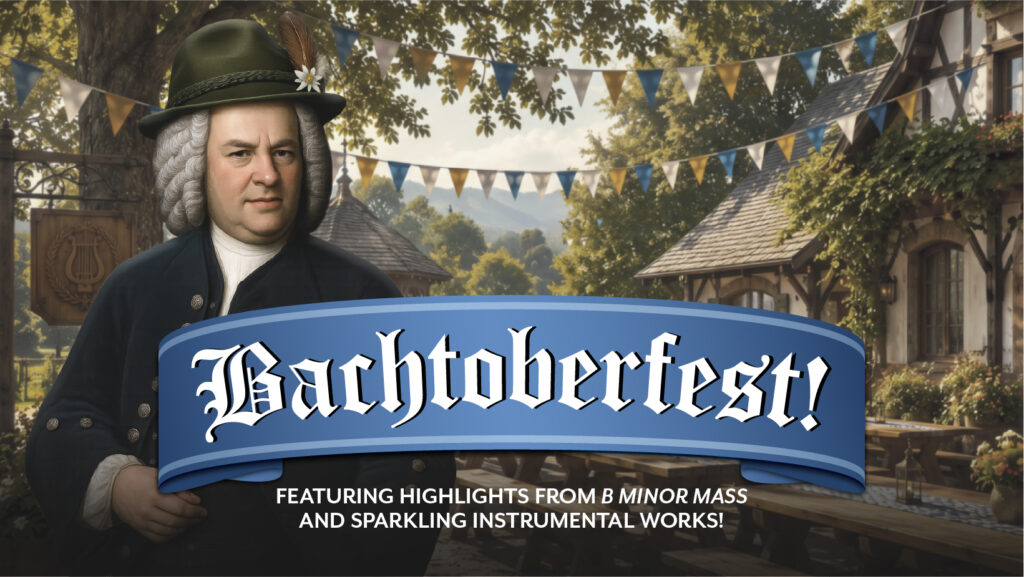
Bachtoberfest!
Sunday, October 25, 2026, 4 p.m. | Pre-concert talk, 3 p.m.

BY POPULAR DEMAND: Picked by You, Sung by Us!
Saturday, March 13, 2027, 4 p.m.